

ANÁLISE TÉCNICA, DESENVOLVIMENTO
72% reduction in ALS S360 synchronization time
Evo Systems optimized the synchronization process of ALS S360—an application used by ALS Global in field operations—reducing synchronization time from 182 to 50 seconds without rewriting the system architecture.


Executive summary
ALS Global needed to improve the performance of ALS S360, an application used by technicians to record industrial fluid samples in environments with limited connectivity. Following a technical analysis of the existing architecture, Evo Systems identified bottlenecks in the synchronization process and implemented targeted optimizations that reduced synchronization time by 72%, while preserving the application's entire structure.
Challenge
ALS Global is a global leader in testing, inspection, and certification services, operating in over 70 countries. In Brazil, its tribology division performs industrial fluid analysis, requiring technicians to collect samples directly at industrial plants.
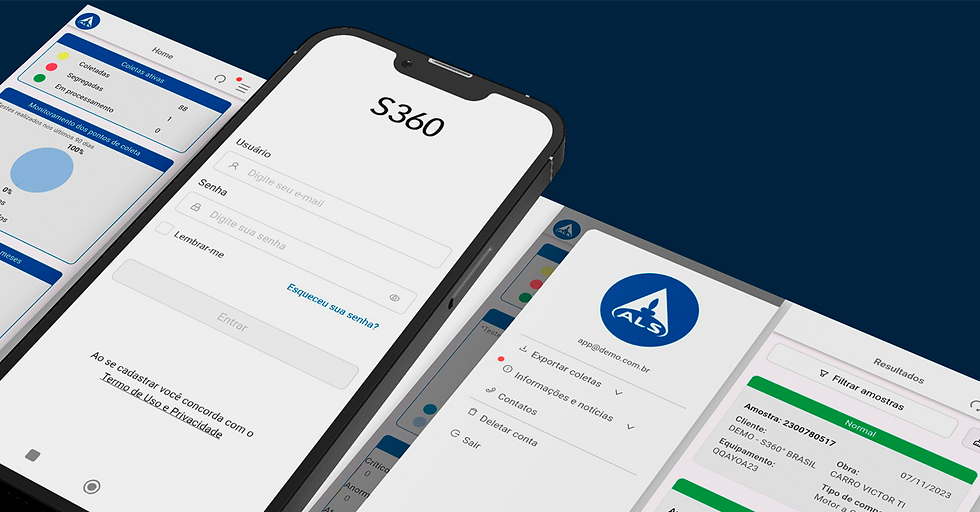
To support this work, the company uses ALS S360, an application designed to operate offline during inspections and synchronize data once a connection becomes available.
Although the application met operational needs, data synchronization had become a bottleneck. Each process took approximately 182 seconds to complete, increasing technician wait times and delaying the start of analyses.
ALS Global needed to improve this performance without replacing the application or completely restructuring the solution.
Strategy
Evo Systems began the project by conducting a detailed analysis of the ALS S360 architecture and source code, aiming to pinpoint exactly where performance bottlenecks existed.
The goal was not to rebuild the system, but to understand synchronization behavior and address only those areas that significantly impacted performance.
The investigation evaluated the entire communication flow between the application and the server—analyzing API calls, data traffic volume, and synchronization logic—thereby identifying optimization opportunities without altering the existing architecture.
Transformation_
The analysis revealed two factors directly impacting synchronization time.
The first was the presence of redundant server calls. During each synchronization, certain operations were executed multiple times, resulting in unnecessary processing and increasing the total workflow duration.
The second factor related to the APIs used by the application. Some endpoints returned complete datasets when only a small fraction of that data was actually required for the process, thereby increasing the volume of data transferred between the server and the application.
Once the bottlenecks were identified, Evo Systems implemented optimizations directly within the existing code.
Redundant calls were eliminated, endpoints were configured to transfer only the necessary information, and the synchronization workflow was refined to reduce processing and data traffic.
The entire intervention was carried out while preserving the system's original architecture, thereby avoiding the risks typically associated with complete rewrites.
Results
The optimizations reduced the average synchronization time from 182 seconds to 50 seconds, representing a reduction of approximately 72%.
Key results achieved include:
- 72% reduction in synchronization time;
- reduced wait time for field technicians;
- faster start to the sample analysis process;
- optimization achieved without changes to the application architecture;
- implementation completed in approximately 110 hours;
- preservation of the existing system's stability and functionality.
Technologies used
Flutter (Dart)
The ALS S360 was developed using Flutter, a technology employed throughout the analysis and optimization of the synchronization process. The improvements were implemented directly within the existing application, preserving its architecture and functionality.
Conclusion
Performance issues do not always require complete rebuilds. In many cases, an in-depth technical analysis is sufficient to identify specific bottlenecks and yield significant performance gains.
With ALS S360, Evo Systems demonstrated that targeted interventions can drastically reduce synchronization time, increasing operational efficiency without compromising product stability.
Frequently Asked Questions
What was optimized in the ALS S360?
Evo Systems analyzed the application's synchronization process and implemented improvements to API calls and the communication flow between the app and the server.
How much time was saved?
The average synchronization time dropped from 182 seconds to 50 seconds—a reduction of approximately 72%.
Was it necessary to rebuild the application?
No. All improvements were implemented while preserving the existing architecture, without the need to rewrite the application.
What benefits did this optimization bring?
The reduction in synchronization time decreased wait times for field technicians, accelerated the start of analyses, and improved operational efficiency without altering the user experience.

Ready to get started?
Get in touch to talk more about your business challenges.
TALK TO A CONSULTANT
(11) 3164-4000
contato@evosystems.com.br
SCHEDULE A VISIT